about aigan
the aigan project was created to further explore ai technologies and to challenge the view that machines can’t reach human creativity
the word aigan derives from ai (artificial intelligence) and gan (general adversarial network) with the latter being the name of the artificial neural network architecture which is heavily used in this project
the fascination of ai generated art lies in the fact that it is impossible to tell why and how the computer ended up with the generated pictures – in a sense it learned to express itself in the form of art
technology
the first computer generated artworks were done in the 1960s but only in recent times has computational power been increasing enough to power neural network architectures that can handle huge amounts of pictures as input
general adversarial networks (gans) were invented by ian goodfellow in 2014 and since then have been used in countless tasks in the field of unsupervised learning with art creation being one of the first applications that have been studied
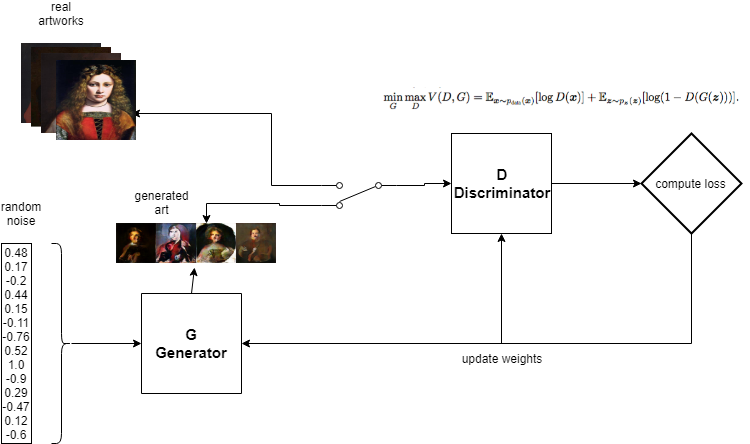
the architecture consists of two sub neural networks – the generator and the discriminator
both networks are engaged in a zero sum game to outperform the other – the discriminator is rewarded for being able to discriminate between real artworks and pictures that are generated by the generator, and the generator is rewarded for fooling the discriminator by generating pictures that are close to the data distribution that have been used to train the discriminator

the generator starts off by generating random noise and over time learns to capture the essence of the input data distribution
training an adversarial network is notoriously unstable and difficult so the field is ever evolving